
We are looking to get to know our CVAA members better....and introduce you all to each other! We have so many members across care settings, across the country, across disciplines - we'd love to feature you and the type of work you do! Email Melissa at cvaa@cvaa.info to be featured.
Next up, meet David-Alexandre Morin!
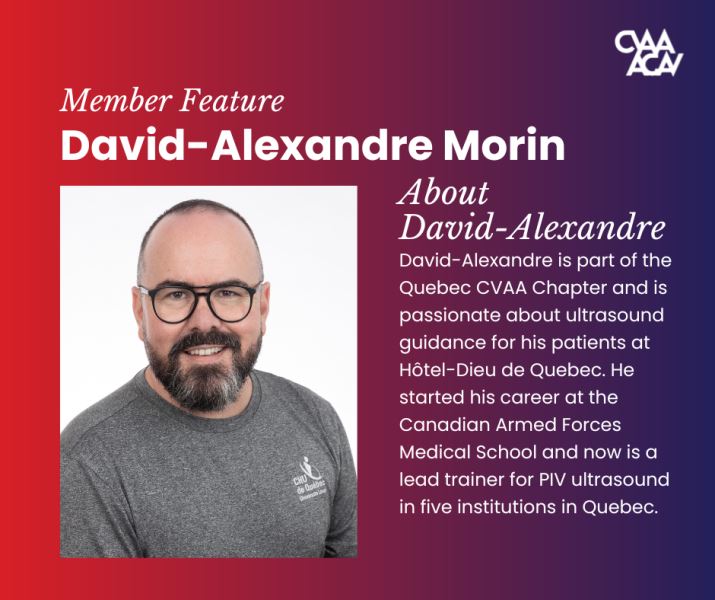
English to follow
- Dans quel type d'organisation ou d'hôpital travaillez-vous ?
Je suis infirmier au soins intensifs de l'Hôtel-Dieu de Québec et cumule près de 24 années de services. L’Hôtel-Dieu de Québec se distingue comme un établissement de pointe dans les secteurs de l’oncologie et de la néphrologie au Québec et demeure un centre tertiaire de soins. À noter que l'Hôtel-Dieu de Québec est le plus ancien établissement hospitalier au nord du Mexique. Il est un hôpital de soins, d’enseignement universitaire et de recherche au Québec.
- Comment avez-vous entendu parler de l'ACVV pour la première fois ?
J'ai entendu parlé du CVAA après m'être intéressé à un article publié par mme France Paquet, une infirmière chevronné en installation d'accès vasculaires qui m'a assurément inspiré.
- Quel est le rôle de l'accès vasculaire et de la thérapie par perfusion dans votre journée de travail ?
Les patients des soins intensifs de l'Hôtel-Dieu de Québec ont divers type de cathéters veineux, autant centraux que périphériques. Au fil des ans, j'ai développé mon expertise vis à vis les accès veineux grâce aux enseignements reçus par l'entremise de mon travail en soins intensifs.
- Pourquoi êtes-vous passionné par l'accès vasculaire/la thérapie par perfusion ?
J'ai découvert ma passion envers les accès vasculaires à l'école du services de santé des Forces armées canadiennes, Borden, Ontario. Le premiers cathéters veineux périphériques que j'ai installé a été sur un soldat des Forces armées canadiennes lorsque j'avais 18ans.
Aujourd'hui, je me trouve à être un expert et formateur en échoguidage de voies périphériques et ce, dans les cinq établissements universitaires du CHU de Québec. J'ai publié un article via le CVAA Link e-newsletter à propos des bases de l'échoguidage. De plus, j'ai offert la formation d'installation de DAVP échoguidés aux médecins qui offrent l'aide médical à mourir à domicile et également donné des conférences sur les cathéters périphériques ultra-longs offert par la compagnie Bbraun. Depuis quelques années, je fais parti de SONONURSE, une équipe d'ingénieurs de l'ETS, chercheurs, médecins. SonoNurse est une entreprise qui possède un brevet en écho guidage pour le maintien de l’aiguille dans le plan de la coupe échographique (2D épaisseur 1mm sur une longueur de 5cmX 4cm de profondeur).
Ce projet novateur s’agit d’un appareil qui apporte une modification de structure des sondes d’échographie et de leur mécanique (points de pression) pour les adapter aux techniques d’écho guidage en vasculaire sans écraser les structures molles en dessous de la peau.
Cela permettra à un opérateur débutant de maîtriser le maintien de l’aiguille dans le plan échographique en quelques heures, ce qui, normalement, lui prendrait des mois de pratique en immersion à corriger.
- Êtes-vous certifié(e) CVAA(c) ? Prévoyez-vous d'assister à la 50e conférence annuelle de l'ACVV à l'Île-du-Prince-Édouard l'an prochain ?
Je ne suis pas certifié CVAA mais, cela reste un objectif de carrière. J'aimerais assurément prendre part à la 50e conférence annuelle en tant que présentateur.
- Dites-nous une anecdote amusante à votre sujet :)
J'aime beaucoup trop les Tatouages... 🙂
-------------------------------------------------------------------------------------------------------------------------------
What sort of organization/hospital do you work at?
- I am a nurse in the intensive care unit at Hôtel-Dieu de Quebec. I have almost 24 years of service. Hôtel-Dieu de Québec stands out as a leading institution in the fields of oncology and nephrology in Quebec and remains a tertiary care centre. Hôtel-Dieu de Québec is the oldest hospital north of Mexico. It is an acute care, university teaching and research hospital.
How did you first hear of CVAA?
- I first heard about the CVAA after reading an article published by France Paquet, a nurse experienced in vascular access installations, which certainly inspired me.
How does vascular access/infusion therapy play a role in your typical day?
- Patients in intensive care at Hôtel-Dieu de Québec have various types of venous catheter, both central and peripheral. Over the years, I've developed my expertise in venous access thanks to the lessons I've learned through my work in intensive care.
Why are you passionate about vascular access/infusion therapy?
- I discovered my passion for vascular access at the Canadian Armed Forces Medical School in Borden, Ontario. The first peripheral venous catheter I installed was on a Canadian Armed Forces soldier when I was 18. Today, I am an expert and trainer in echo-guidance of peripheral lines in the five university establishments of the CHU de Québec. I published an article in the CVAA Link e-newsletter on the basics of echo-guidance. In addition, I offered training in the installation of ultrasound-guided PADs to doctors who provide medical aid in dying at home and also gave lectures on ultra-long peripheral catheters offered by the B Braun. For the past few years, I've been part of SonoNurse, a team of ETS engineers, researchers and doctors. SonoNurse is a company that holds an ultrasound guidance patent for maintaining the needle in the plane of the ultrasound slice (2D thickness 1mm over a length of 5cmX 4cm deep). This innovative project involves a device that modifies the structure of ultrasound probes and their mechanics (pressure points) to adapt them to vascular ultrasound guidance techniques without crushing the soft structures beneath the skin. This will enable a novice operator to master holding the needle in the ultrasound plane in just a few hours, which would normally take several hours.
Are you CVAA(c) Certified? Are you coming to the CVAA Conference?
- I'm not CVAA certified yet, but it remains a career goal. I would certainly like to take part in the 50th annual conference as a presenter.
Tell us a fun tidbit about you :)
- I love tattoos way too much... 🙂
Next up, meet Valorie Shaddick!
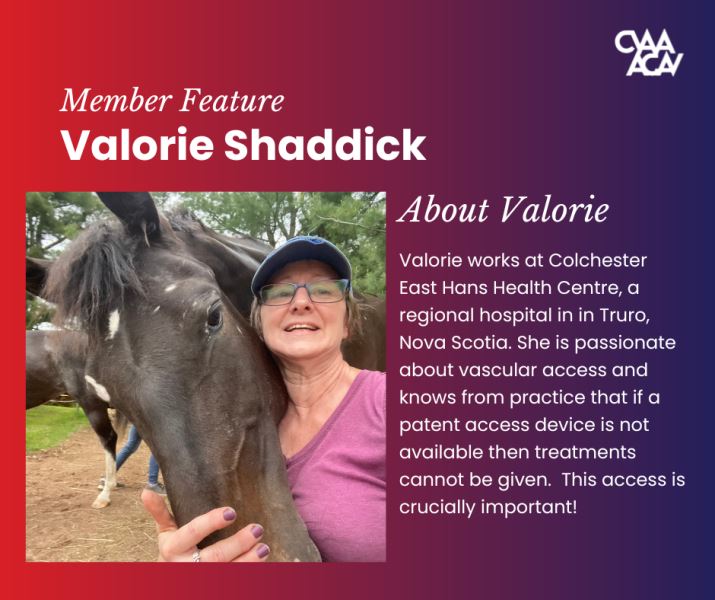
- What sort of organization/hospital do you work at?
I work at Colchester East Hans Health Center, a regional hospital in in Truro NS under the umbrella of Nova Scotia Health
- How did you first hear of CVAA?
CVAA was first mentioned to me through Interprofessional Practice and Learning team in 2014 when I first became a clinical nurse educator at my hospital.
- How does vascular access/infusion therapy play a role in your typical day?
Vascular access has been a large part of my work throughout my career as a frontline RN. After becoming a CNE, I have been responsible to teach best practice around vascular access, help change practice at the bedside and help support certification in vascular access with frontline staff. Many times I have been called on to start PIVs, teach proper care and maintenance and troubleshoot CVAD management on our med/surg units. Now I am part of policy development and skill development to help support clinical practice within the province, facilities and at the unit level.
- Why are you passionate about vascular access/infusion therapy?
Vascular access is a key route for treatment for many of our inpatients in their plan of care therefore it needs to be well managed and the most appropriate device chosen to provide care to our patients. I have worked in critical care settings and know from practice that if a patent access device is not available then treatments cannot be given. To provide much needed treatments, the care and maintenance of these devices are crucially important. I have a passion to see the present and the next generations of health practitioners view vascular access as more than just an entry level, day to day skill/task to be accomplished and be able to manage them in every aspect (infection prevention, occlusion, dressings, etc)
- Are you CVAA(c) Certified? Are you planning to attend the 50th Annual CVAA Conference in PEI next year?
Yes, I am CVAA certified and do plan to attend the conference in PEI next year.
- Tell us a fun tidbit about you :)
I enjoy horseback riding and am presently (with much help) training a young horse to work with into my retirement.
Next up, meet Sam Jennings!
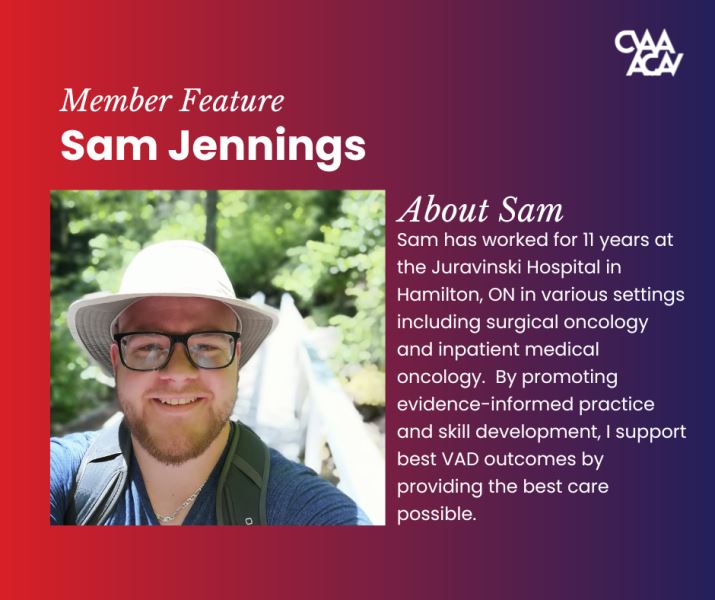
What sort of organization/hospital do you work at?
I've worked for 11 years at the Juravinski Hospital (Hamilton, Ontario) in various settings including surgical oncology and inpatient medical oncology.
How did you first hear of CVAA?
CVAA was mentioned to me by a preceptor while I was in school. However I became most familiar with CVAA through my colleagues at Hamilton Health Sciences.
How does vascular access/infusion therapy play a role in your typical day?
Antibiotic, nutrition, electrolyte, or hydration therapies are a frequent treatments in the populations we serve. Whether using peripheral access, or advocating for safe and effective use of central lines, I provide care using vascular devices to virtually all of the patients I encounter on a daily basis.
Why are you passionate about vascular access/infusion therapy?
Vascular access devices are an incredible tool which, when used wisely and appropriately, improve patient care, experience, and outcomes. By promoting evidence-informed practice and skill development, I support these outcomes by providing the best care possible.
Are you CVAA(c) Certified? Are you planning to attend the 50th Annual CVAA Conference in PEI next year?
I have yet to become certified...It is on my to-do list. I have, though, enjoyed working through some of the exam study session recordings on the member portal and will find these valuable as I actively prepare for the exam.
Tell us a fun tidbit about you :)
I recently finished a cross-Canada road trip! I spent a month in Edmonton for school placement and then carried on to Abbotsford, BC to visit my family before returning to Ontario. This country is absolutely stunning! I encourage anyone to make the drive between Sault St Marie and Thunder Bay at least once - it was spectacular and one of my favourite segments of the drive.
Next up, meet Katelyn Cooper!
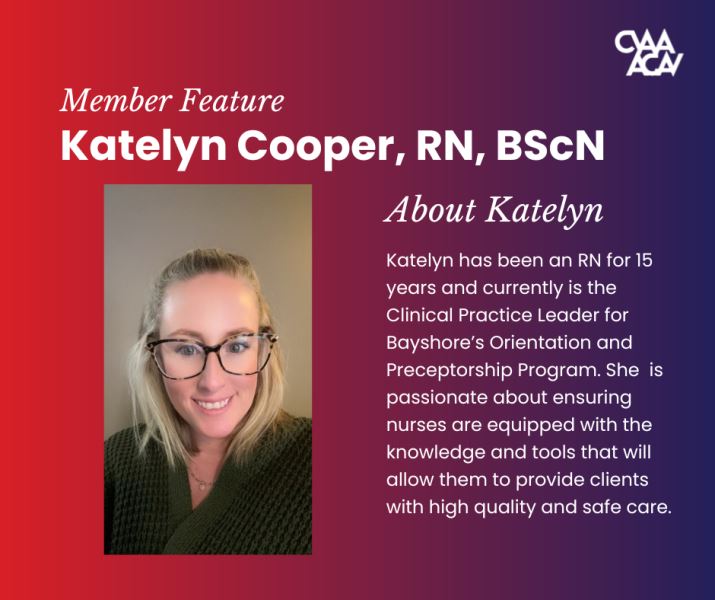
What sort of organization/hospital do you work at?
I have been an RN for 15 years. Currently, I am a Clinical Practice Leader for Bayshore’s Orientation and Preceptorship Program. Prior to that, I worked at Health Sciences North on the Intensive Care Float Team.
How did you first hear of CVAA?
While assisting in the development of our orientation program that is deeply rooted in best practices, CVAA was introduced to me by a fellow colleague as a resource for VAD Standards of Practice
How does vascular access/infusion therapy play a role in your typical day?
I facilitate a biweekly nursing orientation which focuses on many aspects of home and community care, including many clinical skills. We currently have a 4-hour vascular access orientation, in addition to hands on validation of skill- so being up to date on best practice guidelines is essential for successful knowledge transfer.
Why are you passionate about vascular access/infusion therapy?
As a previous critical care nurse and now educator, I am passionate about ensuring nurses are equipped with the knowledge and tools that will allow them to provide clients with high quality and safe care.
Are you CVAA(c) Certified? Are you planning to attend the 50th Annual CVAA Conference in PEI next year?
I am not certified yet, but I am writing the exam soon!
Tell us a fun tidbit about you :)
I am going on my first ever Disney family vacation in October and I am so excited 😊
Next up, meet Catherine Hunt!
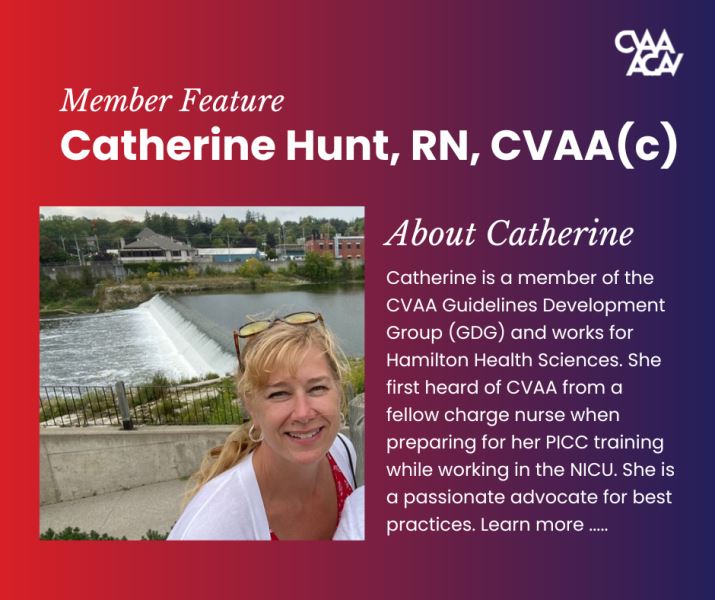
What sort of organization/hospital do you work at?
- I work for Hamilton Health Sciences.
How did you first hear of CVAA?
- I first heard about CVAA from a fellow charge nurse when preparing for my PICC training while working in the NICU.
How does vascular access/infusion therapy play a role in your typical day?
- As an IV nurse in a busy tertiary hospital, one of my main roles is to assess the patients needs, advocate and provided the best vascular access that will last the length of stay. This could range from ultrasound guided PIV, midline or PICC.
Why are you passionate about vascular access/infusion therapy?
-
There are many newer staff in our hospitals that do not have the competency to provide access with limited pokes. Our patients also seem to be more critical and have trickier veins to access. Unfortunately, by the time our team has been consulted the patient’s arms are grossly bruised or have various areas of infiltration and phlebitis. I’m passionate about vascular access because it affects almost everyone that comes into the hospital whether it is one of our clinics, day procedure or admissions. I’ve also been on the receiving end of poor vascular access practice and as a patient understand how hard it is to speak up. Patients shouldn’t have to speak up to receive what is best practice, which fuels my drive to teach and advocate. It is incredibly humbling to receive gratification from the patients and their families when you’ve limited their fears after providing a painless one poke experience.
Are you CVAA(c) Certified? Are you coming to the CVAA Conference?
- I am CVAA certified and plan to attend the 50th Annual CVAA conference in beautiful PEI.
Tell us a fun tidbit about you :)
Next up, meet Julia Casey!
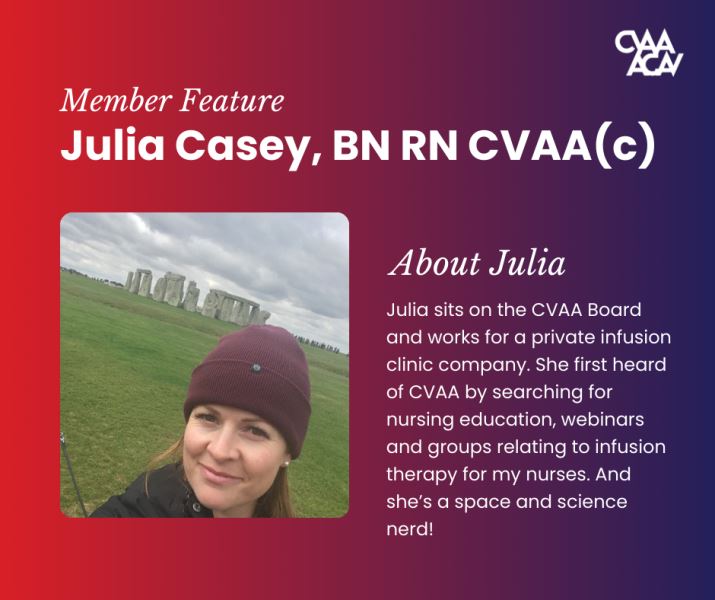
What sort of organization/hospital do you work at?
- I've worked for a private infusion clinic company named Coverdale Infusion Clinics (BioScript Solutions) for the past 13 years, in a few different roles, from a clinic nurse to a trainer, educator and manager.
How did you first hear of CVAA?
- Searching for nursing education, webinars and groups relating to infusion therapy for my nurses
How does vascular access/infusion therapy play a role in your typical day?
- It plays a huge role - we do 90k+ IV treatments a year in our clinic network, mostly by PIV but some CVADs as well, so it's very important to be able to provide treatments on schedule. Many of our patients are long term (CD, UC) and may have been chronically ill, so VA can be a challenge.
Why are you passionate about vascular access/infusion therapy?
- The therapies we do are on tight schedules sometimes, and because our patients have been chronically ill being able to obtain an IV quickly and as painlessly as possible is important. These drugs help patients live like 'normal' people and work, care for their families and enjoy hobbies as long as they get them on schedule. For someone with RA for example, being able to play with their grandkids, enjoy hobbies and their retirement without pain is live changing.
Are you CVAA(c) Certified? Are you coming to the CVAA Conference?
- Yes I am certified, and yes I'll be there with bells on! I love conference week!
Tell us a fun tidbit about you :)
- I am a space and science nerd! I once wrote a series of articles for a science news website about the lack of plate tectonics on Mars and had a website about wild cats.
First up, meet Wendy Goldman!
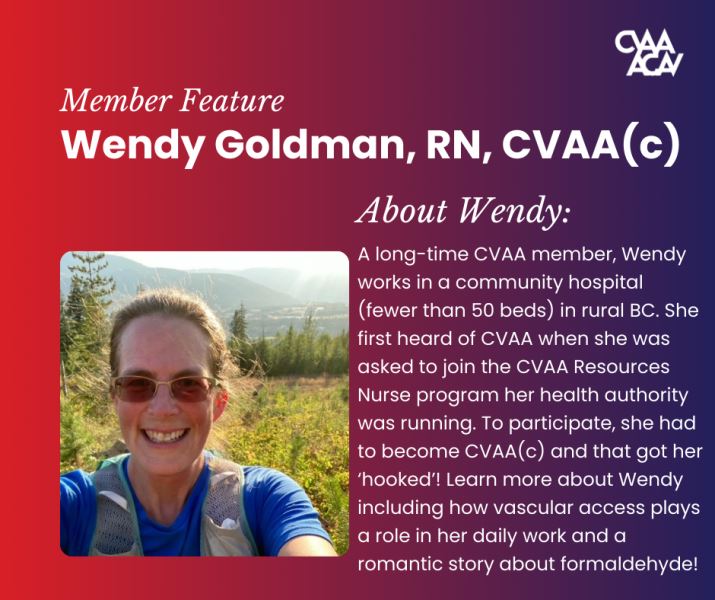
What sort of organization/hospital do you work at?
- I work in a community hospital (less than 50 beds) - for the last 3+ years as a clinical practice educator - in this role I support another rural (10 bed) hospital as well.
How did you first hear of CVAA?
- I first heard of CVAA when I was asked to join the "CVAA Resource Nurse" program that my health authority was doing at the time. To be part of this, I had to get my CVAA certification, so I wrote the exam in January of 2010 and that got me "hooked".
How does vascular access/infusion therapy play a role in your typical day?
- Vascular access / infusion therapy plays into my typical day on an intermittent basis - sometimes I'm called to help out with a challenging clinical situation, or I might be teaching a class with a vascular access component, or I could be doing some learning to try and keep myself current.
Why are you passionate about vascular access/infusion therapy?
- I'm not sure exactly why I love it - since I was introduced to CVAA and this area, it just grew into something I loved knowing and learning about.
Are you CVAA(c) Certified? Are you coming to the CVAA Conference?
- I'm CVAA certified (since 2010), and I'm coming to the conference this April - it's my first time attending, and I'm really looking forward to it.
Tell us a fun tidbit about you :)
- Fun tidbit - how about an unusual romantic meeting story? I met my husband in a biology lab at university, our eyes met across the room ... while dissecting cats. (We've been together for 35 years now, so it wasn't just the formaldehyde.)